NGS & Genomics Explained
A Step-by-Step Educational Journey: From DNA, genes, and mutations to massively parallel Next-Generation Sequencing (NGS) and precision clinical medicine.
The Molecular Journey: From DNA to Targeted Therapy
Understand how molecular genetics works in six intuitive stages. Click each stage below to explore the science and clinical significance.
DNA & The Human Genome
The chemical blueprint of life
Every cell in your body contains approximately 3.2 billion base pairs of DNA (Adenine, Thymine, Cytosine, Guanine). This genetic sequence provides the operating instructions for cellular proteins and biological systems.
- Deoxyribonucleic Acid (DNA) double helix
- Four nucleobases: A, T, C, G
- 23 pairs of chromosomes in human nucleated cells
- Genome size: ~3.2 billion base pairs
Baseline constitutional variations in this code establish baseline biological traits and hereditary disease predispositions.
Precision Oncology & Liquid Biopsies Architecture
Review the clinical architecture of hereditary predisposition panels, solid tumor profiling, and non-invasive liquid biopsy ctDNA assays.
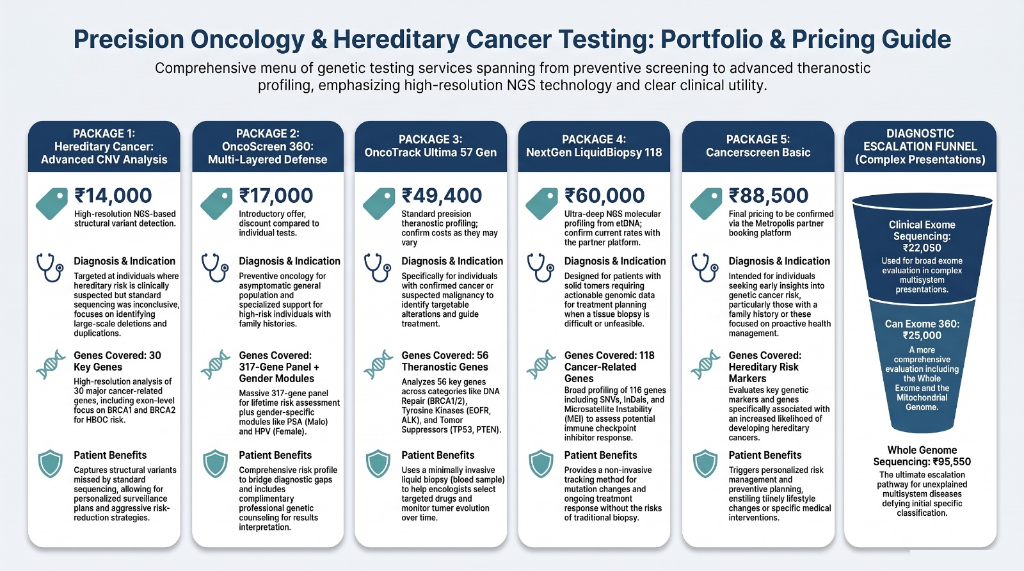
Genomic Diagnostic Modalities & Clinical Evidence
Molecular diagnostics covers multiple specialized applications. Reficio strictly classifies each modality by its regulatory and clinical evidence status.
Somatic Tumor Genomic Profiling
Comprehensive genomic profiling of tumor tissue to identify actionable oncogenic drivers.
EGFR, KRAS, BRAF, ALK, ROS1, RET, NTRK1/2/3, PIK3CA, MET, ERBB2, TP53
- Advanced Non-Small Cell Lung Cancer (NSCLC)
- Colorectal Cancer (mCRC) RAS/RAF/MSI status
Clinical Note: Requires adequate tumor cell content in biopsy tissue. Results must be interpreted in clinical oncology context.
Explore NGS Panel MenuHereditary Germline Cancer Risk
Identifying inherited genetic mutations that elevate lifetime cancer susceptibility.
BRCA1, BRCA2, PALB2, TP53, PTEN, MLH1, MSH2, MSH6, PMS2, CDH1, APC, MUTYH, ATM, CHEK2
- Family history of early-onset breast, ovarian, or colorectal malignancy
- Multiple primary cancers in an individual
Clinical Note: Identifies hereditary predisposition; does not determine certainty of disease development.
Explore NGS Panel MenuPharmacogenomics (PGx)
Testing how an individual’s genetic makeup influences drug metabolism and response.
CYP2D6, CYP2C19, CYP2C9, VKORC1, SLCO1B1, TPMT, NUDT15, DPYD
- Antiplatelet therapy response evaluation (CYP2C19)
- Warfarin dosing support (CYP2C9, VKORC1)
Clinical Note: Clinical co-factors including renal function, hepatic clearance, and concomitant medications remain critical.
Explore NGS Panel MenuLiquid Biopsy & Circulating Tumor DNA (ctDNA)
Detection of tumor-derived fragmented DNA circulating in blood plasma.
Circulating cell-free DNA (cfDNA), actionable driver and resistance mutations (e.g. EGFR T790M)
- Non-invasive profiling when tissue biopsy is inaccessible or exhausted
- Monitoring treatment response and emergence of resistance mutations
Clinical Note: Sensitivity depends on tumor shed rate. Negative liquid biopsy does not exclude localized non-shedding malignancy.
Explore NGS Panel MenuExpanded Reproductive Carrier Screening
Pre-conception testing for recessive and X-linked genetic conditions.
CFTR, SMN1, HBA1/2, HBB, GJB2, Fragile X
- Pre-conception family planning for couples
- Family history of inherited genetic conditions
Clinical Note: Residual risk remains for uncharacterized rare variants or deep intronic changes.
Explore NGS Panel MenuClinical Whole Exome Sequencing (WES)
Diagnostic evaluation of undiagnosed complex pediatric and adult genetic phenotypes.
Complete human coding exome (~20,000 genes, GRCh38 reference build)
- Suspected monogenic genetic syndromes and complex neurological phenotypes
- Undiagnosed rare disease odysseys after negative first-tier testing
Clinical Note: Non-coding regulatory and deep intronic variants outside target probes are not evaluated.
Explore NGS Panel MenuMetagenomic Microbiome & Multi-Omics Profiling
Taxonomic characterization of intestinal microbial ecology and metabolic pathway potential.
Bacterial phyla, Shannon diversity index, short-chain fatty acid biosynthetic pathways
- Chronic functional gastrointestinal symptoms and dysbiosis research evaluation
- Adjunct metabolic and lifestyle optimization studies
Clinical Note: Taxonomic associations provide functional insights; not a standalone diagnostic tool for organic gastrointestinal disease.
Explore NGS Panel MenuEpigenetic DNA Methylation & Biological Age Profiling
Assessment of systemic biological versus chronological age based on CpG island methylation patterns.
DNA methylation status at Horvath / Hannum / PhenoAge CpG loci
- Longitudinal biological age tracking in longevity and wellness protocols
- Cardiometabolic risk factor research stratification
Clinical Note: Provides biological aging estimates; not a diagnostic tool for specific organ failure or malignancy.
Explore NGS Panel MenuRelevant Diagnostic Investigations
Explore verified pathology tests, precision genomic panels, and clinical guidelines related to Next-Generation Sequencing & Molecular Genomics.
Standard & Specialized Pathology Tests
Relevant Precision Genomics Assays
BRCA1, BRCA2, TP53, PALB2 • 10 to 14 working days
6,000+ OMIM-annotated human disease-causing genes encompassing all known Mendelian phenotypes • 14 to 21 working days
EGFR (Exons 18-21), KRAS (Codons 12, 13, 61, 146), NRAS, BRAF (V600) • 7 to 10 working days